Battery Backup Calculator
BatteryBackupCalculator.com — Estimate Your Battery Runtime Instantly
Battery Backup Calculator
Engineering-grade runtime estimation for your home, office, or professional solar setup.
Battery Array Specifications
Power Consumption
Accurate Battery Runtime Estimation
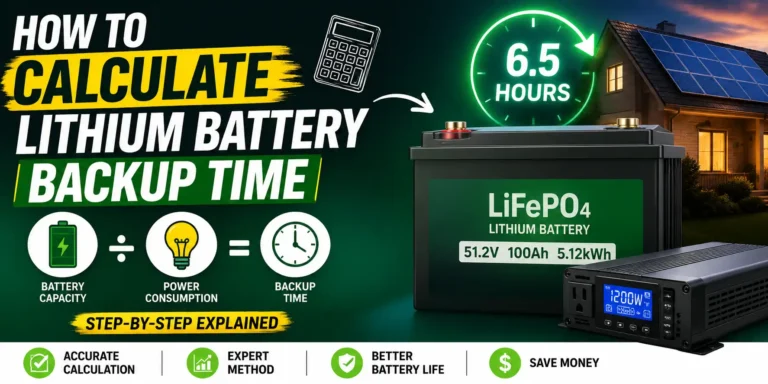
Power outages can happen at any time. Whether you use a lithium battery, lead-acid battery, tubular battery, or a solar battery storage system, one question always comes up: How long will my battery last? That is exactly what this Battery Backup Calculator is designed to answer.
Instead of guessing your battery runtime, this tool helps you estimate your backup time based on real-world factors such as battery capacity, battery type, system voltage, battery efficiency, inverter efficiency, battery health, and connected load. Unlike many simple online calculators, this advanced tool considers multiple battery technologies and system conditions to provide a more realistic estimate.
What Is a Battery Backup Calculator?
A Battery Backup Calculator is an online tool that estimates how long a battery can provide power before it becomes discharged. The calculation is based on:
| Factor | Description |
|---|---|
| Battery Capacity | Total energy stored (kWh) |
| Battery Type | LiFePO4, Li-ion, NMC, Tubular, Lead-Acid |
| Depth of Discharge | Safe usable percentage of battery |
| Battery Efficiency | Energy retained after charge/discharge |
| Inverter Efficiency | DC to AC conversion efficiency |
| Battery Health | Current condition vs. new |
| Connected Load | Total wattage of appliances |
How to Use This Calculator
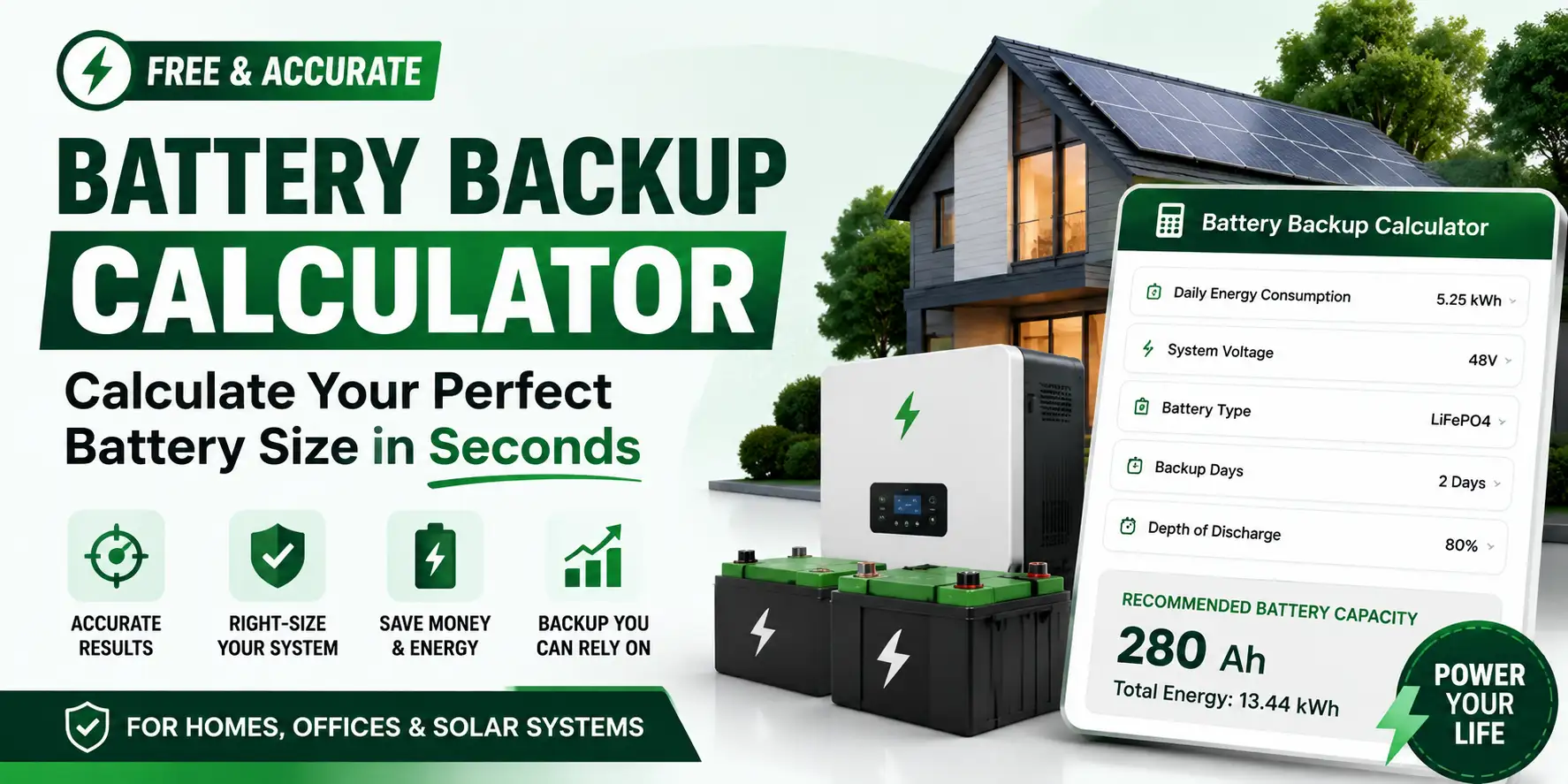
Enter the capacity of one battery in kWh. Examples: Home Battery 5 kWh, Solar Battery 10 kWh, Commercial 15 kWh.
Choose from 12V, 24V, 48V, 51.2V, 72V, 96V, 120V, 240V, or enter a Custom Voltage.
If you have multiple batteries, enter the total count. Example: 5 kWh × 4 = 20 kWh total capacity.
LiFePO4, Lithium-ion, NMC, Tubular, Lead-Acid, or Custom. Each type has different characteristics.
Enter total watts or tap the quick-add buttons. Adjust DoD, efficiency, and health sliders for accuracy.
Click the calculate button to see your estimated backup duration with full engineering breakdown.
Common Appliance Power Consumption
| Appliance | Typical Power |
|---|---|
| Ceiling Fan | 75W |
| LED TV 43″ | 80W |
| Refrigerator | 150W |
| Desktop Computer | 120W |
| Washing Machine | 400W |
| Water Pump 1HP | 350W |
| Electric Iron | 1000W |
| Inverter AC 1.5 Ton | 1300W |
Understanding Efficiency Settings
Depth of Discharge (DoD)
The percentage of battery capacity that can safely be used. LiFePO4: 90-100%, Lithium-ion: 80-90%, Lead-Acid: ~50%.
Battery Efficiency
Energy lost during charge/discharge. LiFePO4: ~95%, Lithium-ion: 90-95%, Lead-Acid: 80-85%.
Inverter Efficiency
DC to AC conversion loss. Basic: 85-90%, Good: 92-95%, Premium: 95-97%.
Battery State of Health (SoH)
Current battery condition vs. new. 100% = brand new, 80% = aging, 70% = old battery. Adjust for realistic results.
Frequently Asked Questions
How is battery backup time calculated?
Using battery capacity, number of batteries, battery type, efficiency factors, depth of discharge, and connected load — all calculated in real-time.
Which battery gives the longest backup?
LiFePO4 batteries typically provide the longest backup due to high efficiency and deep discharge capability.
Does inverter efficiency really matter?
Yes. A 90% efficient inverter loses 10% of energy as heat. A 97% efficient inverter only loses 3%.
Why is my backup time shorter than expected?
Aging batteries, high power consumption, low efficiency, and surge loads can all reduce actual runtime.
Can I calculate solar battery backup?
Absolutely. This calculator works with all battery types including solar storage batteries.
⚡ Ready to Calculate Your Battery Backup Time?
Use the calculator above to get an accurate estimate in seconds. No signup required.
Calculate NowBattery Knowledge Base
Everything you need to know about battery backup systems